


Teaser 3087: Hexagonia
From The Sunday Times, 21st November 2021 [link] [link]
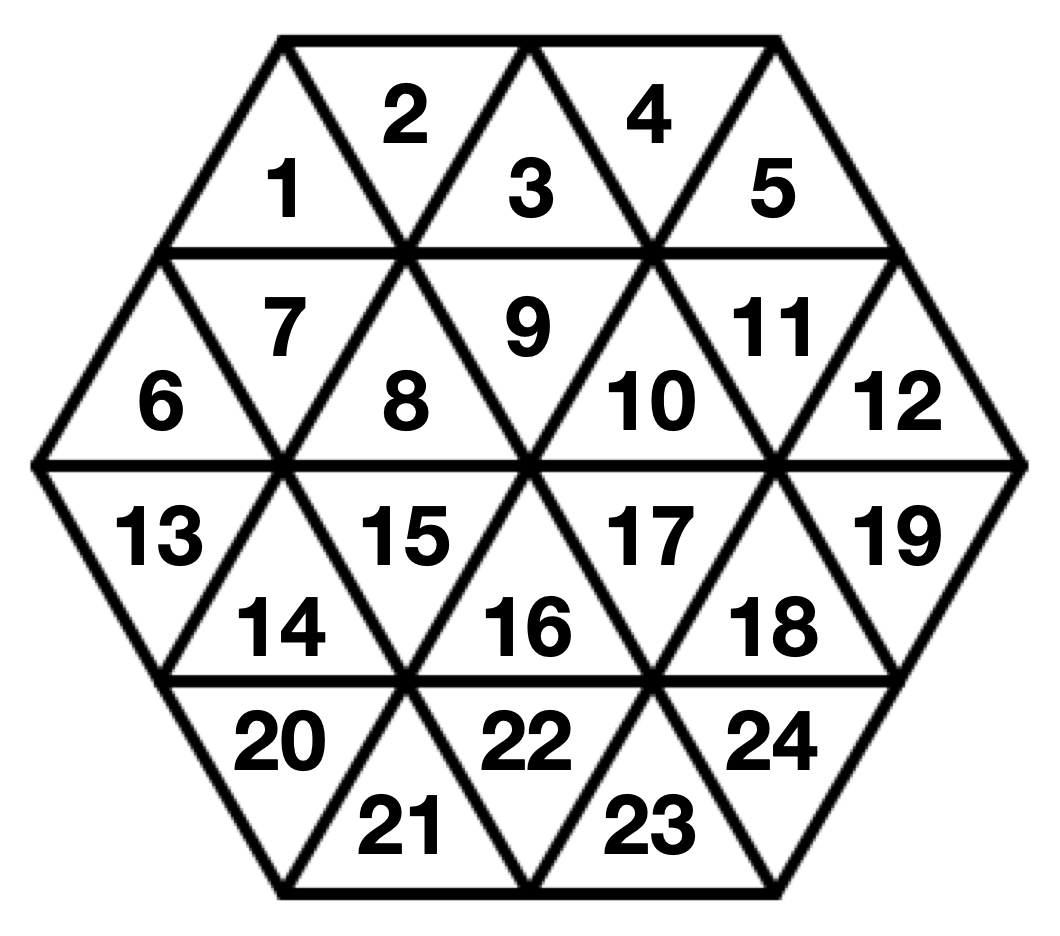
Hexagonia is a hexagonal republic and is divided into 24 numbered counties, as shown. The counties are to be reorganised into four departments, each composed of six edge-connected counties. No two departments will have the same shape or be reflections of each other, and the president’s residence in Department A will be built on an axis of symmetry of the department. Every sum of the county numbers in a department will be, in the prime minister’s honour, a prime number, and her mansion will be built in the middle of a county in Department B, on an axis of symmetry of the department, and as far as possible from the president’s residence.
In what county will the Prime Minister’s mansion be built?
This is the next puzzle after Teaser 2401 whose number has the property described in Teaser 2700.
[teaser3087]
 Frits and
 S2T2
S2T2 
Jim Randell 5:30 pm on 19 November 2021 Permalink |
It looks like I implemented my polyiamonds.py module at just the right time (see Teaser 2838).
I added the other hexiamonds to it and then used it to generate the only possible map. From this we see there are only 2 achiral shapes involved, and only one of them has an axis of symmetry that passes through the counties, so the required answer is determined directly from the map.
The following Python program runs in 1.16s. Although by limiting the sets of pieces tested to those containing 2 chiral shapes, this can be reduced to 668ms.
from enigma import (subsets, join, primes, printf)
import polyiamonds

# collect the possible hexiamonds
shapes = polyiamonds.shapes("O6 I6 C6 E6 F6 G6 H6 J6 P6 S6 V6 X6".split())

# map cells of the 24-hex grid to county numbers
cells = [
  (0, 6), (0, 7), (1, 6), (1, 7), (2, 6), # 1 - 5
  (0, 4), (0, 5), (1, 4), (1, 5), (2, 4), (2, 5), (3, 4), # 6 - 12
  (0, 3), (1, 2), (1, 3), (2, 2), (2, 3), (3, 2), (3, 3), # 13 - 19
  (1, 1), (2, 0), (2, 1), (3, 0), (3, 1), # 20 - 24
]
county = dict((cell, i) for (i, cell) in enumerate(cells, start=1))
grid = set(cells)

primes.extend(130)

# choose 4 of the shapes
for ps in subsets(shapes.keys(), size=4):

  # attempt to fit the shapes into the grid
  ss = list(shapes[p] for p in ps)
  for g in polyiamonds.fit(ss, grid):
    # the sum of the counties in each region should be prime
    t = dict((n, 0) for n in (1, 2, 3, 4))
    for (k, v) in g.items():
      t[v] += county[k]
    if not all(v in primes for v in t.values()): continue

    printf("{ps}\n", ps=join(ps, sep=" ", enc="[]"))
    polyiamonds.output_grid(g)
Solution: The Prime Minister’s Mansion is in county 16.
The layout of the departments is as follows:
The departments have the following prime totals: blue (H6) = 31; red (C6) = 61; green (E6) = 101; orange (J6) = 107.
The two departments with axes of symmetry are the red one (C6) and the green one (E6).
The red one’s axis is along the 6/13 border, so this gives us the location of the President’s Residence (so Department A is red), and the axis in the green department (Department B) is indicated with the dotted line. This passes through counties 15 and 16, but we want to be as far from the President’s Residence as possible, so the Prime Minister’s Mansion must be in county 16.
In fact C6 is the only achiral piece that can give a prime total, and has an axis on a border, so C6 must be involved in the map with one of E6 or V6 (which are the remaining achiral pieces with axes that pass through cells). And the remaining 2 counties must be chosen from F6, G6, H6, I6, J6, P6, S6 (chiral).
LikeLike
Jim Randell 10:28 pm on 19 November 2021 Permalink |
Here is a faster version, where we only consider combinations of 2 achiral and 2 chiral pieces, and positions of pieces in the grid are only considered if the counties involved have a prime sum.
It runs in 67ms.
from enigma import (subsets, join, primes, defaultdict, intersect, exact_cover, printf) import polyiamonds # collect the possible hexiamonds achiral = "O6 C6 E6 V6 X6".split() chiral = "I6 F6 G6 H6 J6 P6 S6".split() shapes = polyiamonds.shapes(achiral + chiral) # map cells of the 24-hex grid to county numbers cells = [ (0, 6), (0, 7), (1, 6), (1, 7), (2, 6), # 1 - 5 (0, 4), (0, 5), (1, 4), (1, 5), (2, 4), (2, 5), (3, 4), # 6 - 12 (0, 3), (1, 2), (1, 3), (2, 2), (2, 3), (3, 2), (3, 3), # 13 - 19 (1, 1), (2, 0), (2, 1), (3, 0), (3, 1), # 20 - 24 ] county = dict((cell, i) for (i, cell) in enumerate(cells, start=1)) grid = set(cells) primes.extend(130) # look for placements that give a prime total ss = defaultdict(list) for (k, vs) in shapes.items(): for cs in polyiamonds.placements(vs, grid): if sum(county[c] for c in cs) in primes: ss[k].append(cs) achiral = sorted(intersect([achiral, ss.keys()])) chiral = sorted(intersect([chiral, ss.keys()])) # choose 2 achiral shapes for ps1 in subsets(achiral, size=2): # and the rest are chiral for ps2 in subsets(chiral, size=2): ps = ps1 + ps2 # look for an exact cover using these pieces for rs in exact_cover(list(ss[p] for p in ps), grid): # output solution printf("{ps}\n", ps=join(ps, sep=" ", enc="[]")) g = dict() for (i, cs) in enumerate(rs, start=1): g.update((c, i) for c in cs) polyiamonds.output_grid(g)LikeLike
Frits 5:20 pm on 20 November 2021 Permalink |
@Jim, you don’t answer the question
LikeLike
Jim Randell 5:48 pm on 20 November 2021 Permalink |
@Frits: I reveal the answers to competition puzzles after the deadline for entries is closed.
LikeLike
Frits 6:57 pm on 20 November 2021 Permalink |
@Jim, I mean that your program doesn’t seem to print in what county will the Prime Minister’s mansion be built. You normally don’t hide the answer in your program output. It doesn’t matter.
LikeLike